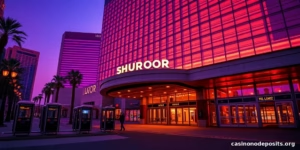


MGM Resorts’ sudden withdrawal from the downstate New York casino licensing competition marks a significant twist in the high-stakes race. The gaming giant had long been considered a frontrunner with its $2.3 billion proposal to expand the Empire City racino in Yonkers, but shifting economic evaluations led the company to step back, leaving three contenders in the ring.
Bally’s Bronx, Metropolitan Park, and Resorts World NYC are the remaining hopefuls, each having submitted revised bids to the state’s Gaming Facility Location Board (GFLB) this week. The projects vary dramatically in scale and cost, with Bally’s planning a $4 billion development, Resorts World proposing a $5.5 billion endeavor, and Metropolitan Park setting its sights on an $8 billion complex. Notably, Resorts World, like MGM, already operates a racino and aims to open its casino in July 2026, while the other two are embarking on entirely new ventures that will require several years to complete and turn profitable.
The GFLB, responsible for evaluating bids based on financial, environmental, and workforce criteria, aims to present its licensing recommendations by December 1. State regulators could then potentially award up to three licenses by year’s end.
Initially, MGM’s bid seemed promising with a slated opening in mid-2027, making it one of the quicker projects to come to market. However, its proposal lacked key amenities such as a resort hotel, public park spaces, or significant community investments, elements that other proposals highlighted. Despite unanimous approval from the appointed community advisory committee (CAC) and support from Yonkers officials, MGM’s decision to exit focused on concerns about the competitive landscape and licensing terms. The company’s proposal banked on securing a 30-year license, though it only qualified for a 15-year term under current capital expenditure guidelines.
Meanwhile, MGM’s abrupt retreat from New York came just days before announcing the sale of its Northfield Park operations in Ohio for $546 million to Clairvest Group. This move suggests a strategic refocus towards digital growth and international opportunities, even as the company maintains its commitment to the Empire City property in its current form.
Industry insiders speculate that MGM might eventually sell Empire City, though the company denies such intentions for now, emphasizing its continued success in Yonkers. Empire City generated $607.4 million in net win for fiscal year 2025, and early reports indicate it is on track to exceed those figures in FY26.
The departure of MGM follows similar exits by Wynn Resorts and Las Vegas Sands earlier in 2025, underlining persistent market and political challenges. Each company cited different reasons for their withdrawal, from concerns over potential iGaming legalization impacting market returns to political hurdles in the zoning process.
Bally’s and Metropolitan Park have also faced political challenges. New York City Mayor Eric Adams has intervened to support Bally’s bid, while Metropolitan Park’s owner, Steve Cohen, navigated legislative obstacles by shifting Senate support.
The remaining contenders must now navigate a complex landscape of economic uncertainties, including rising tariffs, inflation, and slow job growth, which could impact construction costs and timelines. The ability to finance these large-scale projects remains a formidable hurdle, particularly for Bally’s, which continues to face skepticism over its leveraged financial strategy. The company’s reverse merger with Intralot, however, has been touted as a means to secure over $1 billion in capital for the New York project.
Resorts World’s parent company, Genting Berhad, is also actively reshaping its financial structure, selling off properties and expanding its global portfolio to support its New York ambitions. Meanwhile, Metropolitan Park’s financial stability is buoyed by owner Steve Cohen’s significant personal wealth.
Beyond economic challenges, tax rates and licensing fees are critical factors in the decision-making process. Each bidder has proposed different tax rates, with Resorts World notably offering much higher rates on slot and table games compared to its competitors. License fees start at a minimum of $500 million, with bidders free to propose higher amounts, a strategy adopted by Resorts World.
With the GFLB’s recommendations pending, the upcoming months promise more developments in the New York casino saga. The board, comprising members with little gaming experience to ensure impartiality, will be pivotal in shaping the next phase of this high-profile competition. The state’s decision could have significant implications for the gaming landscape in the region, setting the stage for new economic and entertainment opportunities.
Topics: Ohio · Payments · New York · Mergers and Acquisitions · Licensing · Las Vegas
Looking for somewhere to play? Browse our current no deposit bonus listings, with verified codes and the full wagering terms for each offer.
 4.5/5
4.5/5