 Harry Grant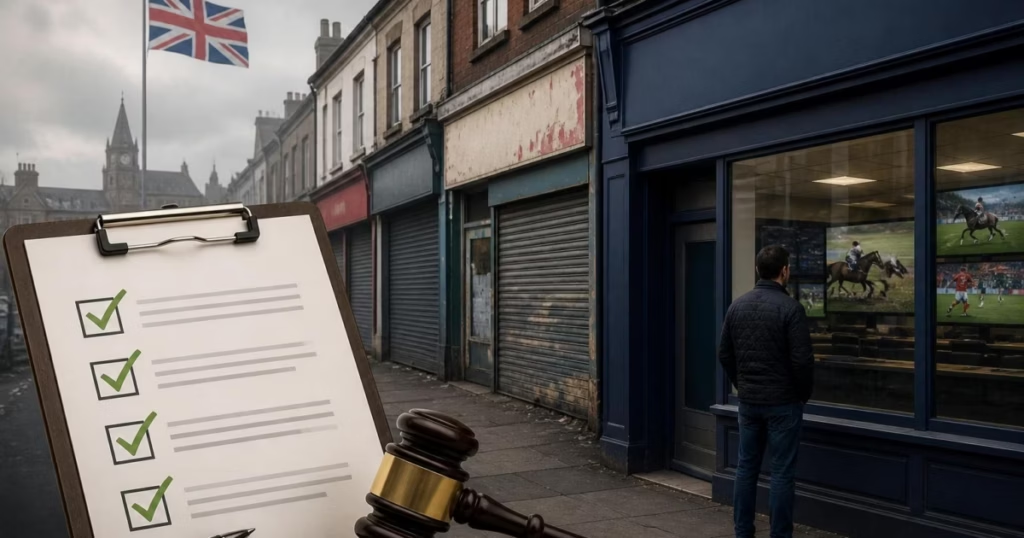
Prime Minister Andy Burnham’s government announced plans to amend the Gambling Act 2005, allowing local councils greater autonomy in rejecting gambling establishment applications. This decision, which was disclosed on Wednesday, is part of a broader strategy aimed at revitalizing the country’s struggling high streets. The policy has incited a strong reaction from the gambling sector, highlighting tensions between government intentions and industry realities.
The proposal eliminates the “aim to permit” clause, which currently restricts local authorities from easily refusing gambling premises applications. Additionally, the requirement for planning permission for new adult gaming centres is introduced. Burnham’s comments, equating betting shops with vape shops and labeling them as undesirable businesses, have further agitated industry stakeholders. The Prime Minister contends that these establishments have supplanted sought-after community spaces and services. This narrative has drawn criticism from industry leaders who argue that the portrayal is unfair and disconnected from the actual decline of betting shops in recent years.
Greg Knight, CEO of JenningsBet, expressed dismay at the characterization of betting shops as “dodgy businesses,” noting that the sector employs approximately 40,000 people and contributes significantly to the British horseracing industry and public funds through taxes. He highlighted the contraction of retail betting, pointing out the reduction from nearly 9,000 shops in 2015 to fewer than 5,900 today, alongside minimal growth in his own company’s retail presence.
The Association of British Bookmakers and other industry representatives argue that betting shops have not driven away traditional retail businesses, but rather filled the void left by them as online shopping and supermarkets have reshaped consumer habits. Alistair Gair, Communications Director at Bacta, a trade association representing adult gaming centres (AGCs), echoed this sentiment. He pointed to a decrease in AGC numbers from 1,610 in 2015 to 1,502 last year, arguing that these venues provide regulated, low-stakes entertainment and occupy spaces that might otherwise remain vacant.
Critics of the proposed regulatory changes, such as Christopher Snowdon of the Institute of Economic Affairs, assert that the government is misunderstanding the problem. Snowdon believes that betting shops did not cause the decline of high streets but became more prominent as other retailers left. He argues that restricting businesses that can still operate will not restore past retail dynamics and that the high street has fundamentally shifted towards service-based businesses like cafés and barbers.
Meanwhile, Richard Harris, CEO of Rank Group, defended the industry by emphasizing the community role of gambling venues, which he described as assets providing safe and supervised entertainment. He stressed the importance of maintaining a commitment to customer care and entertainment despite regulatory challenges.
Amidst these discussions, Patrick Jay, a consultant and former executive at William Hill, criticized the sector for failing to effectively counter negative public narratives. He called for a more proactive approach in addressing misconceptions and media portrayals, suggesting that the industry needs a strategic response to misinformation and negative perceptions.
The newly appointed minister responsible for gambling, Vicki Foxcroft, now faces the challenge of navigating an industry feeling unjustly criticized and a government determined to implement reforms. The legislative process ahead will involve complex questions regarding the balance between revitalizing high streets and maintaining viable business operations.
As these regulatory changes are deliberated, industry stakeholders will be closely monitoring the potential impacts on market access and operational strategies. The timeline for these changes remains to be clarified, with further consultations likely to shape the final legislative framework. The sector’s response and adaptation to these developments will be crucial in determining the future landscape of the UK’s gambling industry.
Topics: United Kingdom · Gambling Taxes · Gambling Regulation
Looking for somewhere to play? Browse our current no deposit bonus listings, with verified codes and the full wagering terms for each offer.