
In 2024, South Korea’s casino industry achieved a gross gaming revenue of nearly KRW3.23 trillion (US$2.30 billion), marking an 18.3% increase compared to the previous year. Additionally, the 17 casinos in the country that permit only foreign visitors experienced a 42.4% rise in attendance.
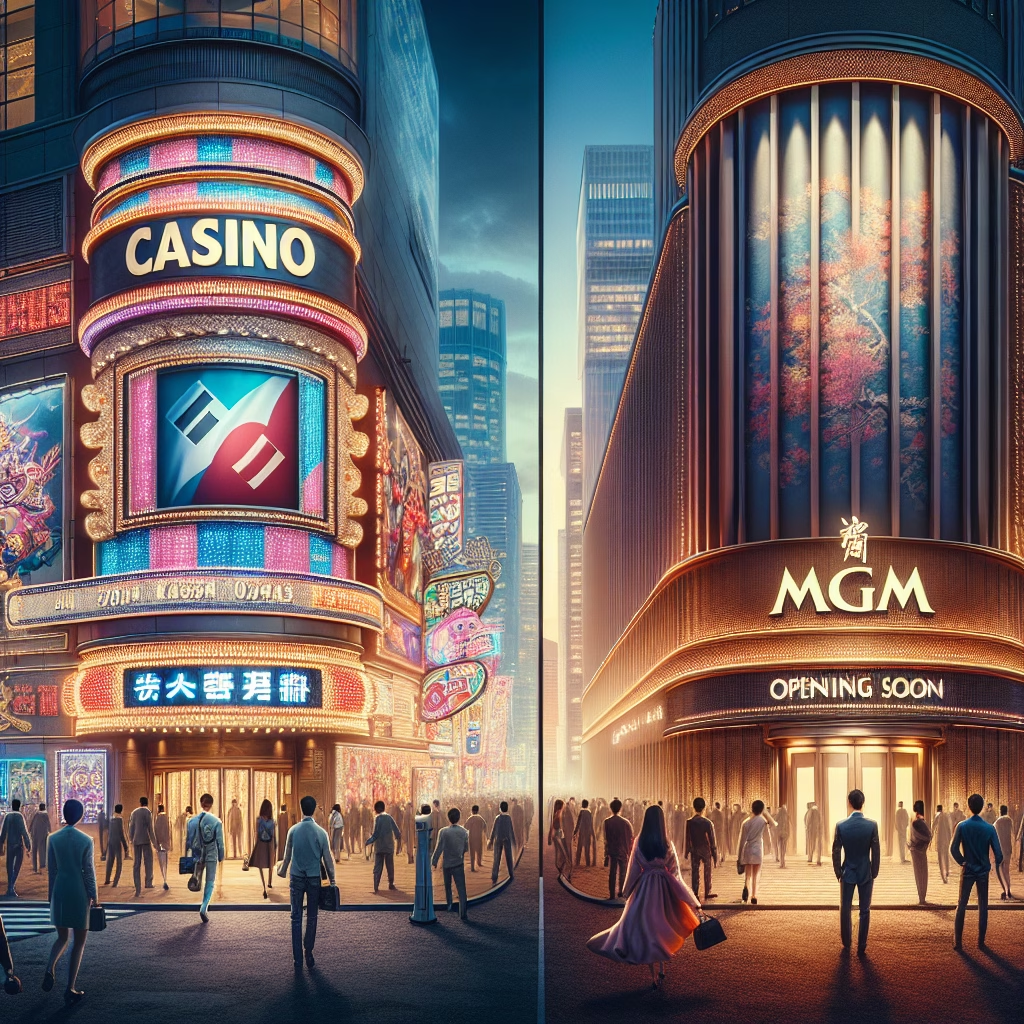
However, this growing momentum may face challenges due to increasing regional competition. The upcoming launch of Japan’s first integrated resort, MGM Osaka, in 2030 is expected to attract around 20 million visitors annually, of which up to 7.6 million may be from Korea.
During a roundtable discussion organized by the Korea Times, hospitality and tourism leaders expressed concerns about Japan’s potential impact on South Korea’s domestic industry. They emphasized the urgency for South Korea to adopt the integrated resort (IR) model, which combines hotels, restaurants, shopping, and entertainment with gaming as a central feature.
For instance, MGM Osaka is set to offer not only a casino but also three hotels with a total of 2,500 rooms, 37,000 square meters of conference and exhibition spaces, a retail district, a 3,500-seat theatre, and a Japanese cultural museum. MGM President and CEO Bill Hornbuckle highlighted the plan to bring MGM’s renowned Vegas-style “wow” factor to Osaka.
At the Seoul roundtable, Lee Min-jae from the Integrated Resort Tourism Research Centre noted that South Korea is already trailing behind other markets like Macau and the Philippines. The situation is anticipated to become more challenging with the opening of Japan’s IR, which is a mere 90-minute flight from Incheon.
“Our casino industry remains overly focused on tax revenue and job creation,” Lee stated. “Globally, the emphasis has shifted towards integrated resorts, recognized as pivotal in driving tourism and regional development. South Korea needs to quickly align itself with this trend.”
“There was a time when casinos were seen as the last resort for rejuvenating struggling local economies,” observed Yoon Tae-hwan, a professor of hotel and convention management at Dong-eui University. “Now, they’ve evolved into vital tourism assets, transitioning from VIP-centric venues to expansive cultural and entertainment hubs for the broader public.”
South Korea has been gradually moving towards this IR model. Paradise City in Incheon, which launched in 2017, offers a hotel, theme park, and meeting facilities. Similarly, Jeju Shinhwa World opened in 2018 on Jeju Island with comparable attractions. Inspire Entertainment, which opened in March 2024, goes further with three hotels, a 15,000-seat arena, a glass-domed water park, and a large outdoor entertainment area.
Kangwon Land, the sole casino in South Korea that welcomes locals, is also adopting elements of the IR model. The company announced a KRW2.5 trillion plan to expand its casino space and introduce additional non-gaming amenities. By increasing the size of its performance venues and retail offerings, and tripling the number of restaurants, it aims to enhance non-gaming revenue from 13% to 30% by 2032.
In a 2024 commentary in the Korea Times, Osaka researcher Yang Hyung-eun argued that South Korea has delayed advancing its IR industry for too long. “Innovation begins with transitioning to an integrated resort industry policy for future growth,” he wrote. “Now is the time to articulate a future vision and philosophy for South Korean casinos.”
At the recent conference, tourism professor Lee Jae-seok from Gangneung-Wonju National University pointed out that, unlike in Japan or Singapore, South Korea lacks a centralized gaming authority. Currently, the Ministry of Culture, Sports and Tourism is responsible for licensing, whereas the National Gambling Control Commission handles regulations.
“The National Gambling Control Commission’s role is too fragmented to be truly effective,” Lee commented. “We need a unified body that can both regulate and lead.”
Seo Won-seok, dean of the College of Hotel and Tourism Management at Kyung Hee University and president of the Tourism Sciences Society of Korea, stated that South Korea must determine whether integrated resorts should serve as a tool for revitalizing underdeveloped regions or as core tourism assets. “This should be a central topic in forthcoming discussions,” he suggested.
This week, representatives from the Korea Casino Tourism Association and Korea Tourism Society convened in Osaka to scrutinize MGM’s strategy. Among the attendees was Choi Cheol-gyu, acting CEO of Kangwon Land. He remarked that Korea is at “a crucial juncture to enhance its global standing in integrated resorts.”
While many in South Korea advocate for a shift towards the IR model, others caution against rapid changes without thorough consideration. These voices argue that the unique characteristics of South Korea’s existing casinos, including their exclusive focus on international visitors, offer distinct advantages that should not be overlooked. They stress that any transition to an IR-focused industry should be accompanied by strategic planning and robust support systems to ensure the local market remains competitive and sustainable in the long run.
As the global gaming landscape evolves, South Korea stands at a crossroads, contemplating how best to leverage its casino industry amidst growing regional competition. Whether by fully embracing the integrated resort model or by reinforcing its existing framework, the decisions made today will shape the future trajectory of South Korea’s place in the global gaming and tourism arena.
Topics: South Korea · Philippines · Singapore · Japan · Macau · Licensing
Looking for somewhere to play? Browse our current no deposit bonus listings, with verified codes and the full wagering terms for each offer.
 4.5/5
4.5/5