

On December 4, 2025, the New York Gaming Facility Location Board (GFLB) advanced all three downstate casino finalists—Bally’s Bronx, Metropolitan Park, and Resorts World NYC—towards the licensing stage. This move, however, does not guarantee that they will receive licenses, as the ultimate decision rests with the New York State Gaming Commission (NYSGC), which has until December 31 to make the final ruling.
The board’s decision, detailed in a 30-page rationale, scrutinized the bids more severely than the unanimous approvals might suggest. Despite the need to allocate all three licenses to keep state funding plans intact, particularly for the Metropolitan Transportation Authority (MTA), the board voiced its dissatisfaction with the proposals. Critics in the public and media accused the board of merely “rubber-stamping” the applications without rigorous evaluation.
The board’s report emphasized the necessity for the NYSGC and local officials to enforce the bidders’ commitments, particularly in areas of hiring, diversity, and community benefits. It was projected that the licensees could generate $5.5 billion in gross gaming revenue by 2033, the anticipated year of market stabilization. This projection was considered to fall between the applicants’ estimates.
Bally’s estimates were lower than the board’s expectations, while Metropolitan Park’s projections were closely aligned. Resorts World’s estimates significantly exceeded the board’s forecast due to optimistic assumptions about tourism and high-end gaming.
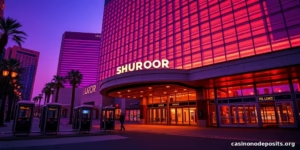
Among the applicants, Resorts World emerged as a favorite due to its quick market entry potential (expected by March 2026) and aggressive tax proposals. It suggested tax rates of 56% for slots and 30% for table games, compared to Bally’s 30% and 10%, and Metropolitan Park’s 25% and 10%. These rates were pivotal in the board’s recommendation, but Resorts World’s later request to align its rates with competitors’ sparked objections from the board.
The board also raised issues with Resorts World’s proposed gaming configurations, stating the facility’s plan for 6,000 slots and 780 tables was not feasible and recommended scaling down to 4,635 slots and 534 tables to maintain visitor experience quality.
Moreover, the project’s $7.5 billion cost, with Resorts World’s investment at $3.3 billion, was scrutinized for its limited local impact—only 1% of investments were set to benefit firms in Queens. This was surprising considering the facility’s positive community support in Queens. The board found Resorts World’s community benefits difficult to quantify, noting that promises seemed speculative and urging the NYSGC to ensure commitments are met regardless of property ownership issues.
Resorts World’s parent company, Genting, while experienced in large-scale developments, has a history of projects exceeding budgets and deadlines. The board expressed concern over the lack of transparency regarding fines at existing properties, recommending the NYSGC consider this in their evaluation.
Conversely, Bally’s proposal was less critically received, with positive notes on its hiring and diversity commitments. Bally’s investment of $2.3 billion in the $4 billion project represents the largest private investment in the Bronx’s history. Nevertheless, its high leverage and limited experience with large projects raised concerns, although its partnership with Gaming and Leisure Properties (GLPI) provided substantial financial backing.
There were issues with Bally’s benefits package valuation, which the board suspected might be overestimated. Additionally, the project’s parking structure and internal diversity metrics attracted criticism, with calls for improved executive diversity in the Bronx project.
Metropolitan Park’s proposal, backed by Hard Rock and Mets owner Steve Cohen, received the least criticism, praised for financial stability and a strong development track record. The project, costing $8.1 billion with a $5.3 billion capital investment, is strategically located near major entertainment venues, promising high visitor numbers. However, unresolved parking and traffic plans, as well as vague community benefit promises, were flagged. The board recommended specific commitments for affordable housing and the proposed “Flushing SkyPark.”
As the NYSGC deliberates, the future of these casino projects remains uncertain. Regardless of the board’s recommendations, the commission has the final authority to weigh these findings and determine the fate of New York’s downstate casino landscape.
Topics: New York · Partnerships · Licensing · Gambling Taxes · Financial Results · Enforcement
Looking for somewhere to play? Browse our current no deposit bonus listings, with verified codes and the full wagering terms for each offer.
 4.5/5
4.5/5