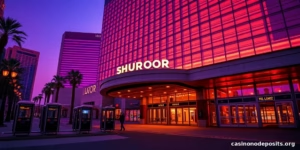


Silverstein Properties and its associates are vying for one of the three coveted downstate New York casino licenses with their proposal for the Avenir integrated resort on Manhattan’s West Side, just a stone’s throw from the Javits Center. On Wednesday, the Javits Center played host to Avenir’s first public hearing, organized by the community advisory committee overseeing the project. With a binding vote scheduled by 30 September, the committee must conduct at least one more public hearing. To advance the proposal, Silverstein needs four out of six committee members to vote in favor.
Avenir is one of three casino bids in Manhattan, a borough densely populated and full of diverse communities that would be significantly impacted by the development of such a multibillion-dollar project. It comes as no surprise that the hearings in Manhattan, including Avenir and Caesars Times Square, have sparked more extensive discussions than any others held to date. The recent five-hour session saw over 100 participants who expressed varied opinions on the project.
Silverstein Properties has a history of goodwill among Manhattan residents, partly due to its role in revitalizing the World Trade Center site post-9/11. Despite this, the reception to the Avenir project remains mixed.
Silverstein Properties, the driving force behind the Avenir bid, began the hearing with an extensive presentation, addressing specific concerns raised in a prior gathering on 16 July. Leading the charge was Silverstein CEO Lisa Silverstein, daughter of the company’s founder, Larry Silverstein. The company owns a vacant plot at the corner of 41st Street and 11th Avenue, which they argue is best suited for casino development due to the high costs and infrastructural challenges that would accompany other projects.
Since its inception, the Avenir proposal has undergone significant modifications. The design has shifted from two connected structures to a singular building. Partnering with Destinations by Hyatt and Rush Street Gaming, Silverstein has also increased its commitment to affordable housing to 500 units and plans to include a community art gallery along 11th Avenue. The project, estimated to cost $7 billion, is poised to transform the area.
“Our site is fully zoned and shovel-ready,” Lisa Silverstein emphasized. “There won’t be any need for conversion, teardown, rezoning, or tenant relocation. It’s an empty lot in a low-density area, and it needs an economic driver to bring life and vibrancy, which in turn enhances safety.”
In a bid to foster community engagement, Silverstein COO Dino Fusco announced that a separate conference room would be available for follow-up inquiries post-hearing. Fusco highlighted the company’s extensive history in residential developments, aiming to alleviate concerns about housing commitments, a particularly contentious issue in the borough.
A core concern for the Avenir project is the potential increase in traffic congestion and crime. While these issues were addressed during the presentation, they remained significant points of contention for local residents who remain skeptical of the company’s assurances. Environmental consultant Connor Lacefield presented an ideal transportation model for accessing the casino, proposing that 40% arrive by subway, 25% on foot, 20% by car, and 15% via bus.
Unlike other bids in areas like Coney Island, which include provisions for thousands of parking spaces, Silverstein is advocating for a free shuttle service and other incentives to minimize car travel. However, the project would still contribute additional traffic, particularly at nearby intersections.
“The intersections near this area will be most affected,” Lacefield noted, “but even with Avenir’s vehicle trips, they would constitute only about 2% of the total traffic, a minimal addition to neighborhood congestion.”
Bill Dacunto, Silverstein’s security chief, outlined additional safety measures, including the establishment of an NYPD substation, on-site EMTs, medical facilities, and collaborations with local community safety groups.
Rush Street Gaming’s CEO, Tim Drekhoff, spoke about the company’s role in the project. Known for managing regional casinos predominantly in suburban areas, Drekhoff expressed confidence in their ability to develop the Avenir casino from scratch. “We’ve never acquired a casino; we develop them from the ground up. We’ve been the first casino in each of our host cities. We’ll bring that specialized experience to the far West Side,” he stated.
The casino bids in New York have revealed a pattern: unions, business groups, and vendors generally support such projects, whereas the residents of the targeted communities are often resistant. Silverstein’s established rapport with unions, having developed multiple high-rises in the city, could play positively in this scenario. “Silverstein Properties has been a steadfast ally of the building trades for decades,” mentioned Mike Vastarelli of the NYC District Council of Carpenters. “Their commitment isn’t just talk; it’s demonstrated through action, year after year, project after project.”
Avenir also aims to address food insecurity by partnering with Rethink Food, a nonprofit dedicated to redistributing commercial food waste to under-served communities. Rethink, which works with several similar city organizations, found in Avenir a responsive ally. “We reached out to all providers, and Avenir was the only one to respond, eager to tackle excess food and sustainability issues,” shared Rethink CEO Matt Jozwiak.
However, not all feedback was favorable. Many local residents voiced strong opposition. While some residing in Silverstein’s existing developments voiced support, many others, particularly from nearby ZIP codes 10036 and 10018, expressed dissent. “Our elected representatives, those we vote for, should defend us against this predatory business,” urged local resident Jacqueline Lowry. Critics argue that the pressing need in NYC is more housing, not a casino, despite Avenir’s increased housing commitment to 2,000 units, including 500 affordable ones.
Adding another layer to the discussion, former Tropicana Las Vegas employee James Jorasch shared insights on casino revenue trends, pointing out that revenue tends to plateau and decline, prompting expansions into online sports betting or iGaming. New York, despite a thriving online sports betting market, has yet to legalize iGaming. This potential future expansion could significantly impact the industry’s landscape.
“The decision on whether casinos get a share of online revenue should be determined now, before we approve the casinos,” Jorasch recommended, inviting stakeholders to consider the broader implications of the casino licensing process.
As the deadline for decision-making approaches, the conversation around the Avenir project and other casino proposals in New York continues to evolve, reflecting the diverse and often conflicting interests of the city’s residents, businesses, and policymakers.
Topics: New York · Licensing · Las Vegas · Sports Betting · Land-Based Casinos · Financial Results
Looking for somewhere to play? Browse our current no deposit bonus listings, with verified codes and the full wagering terms for each offer.
 4.5/5
4.5/5