

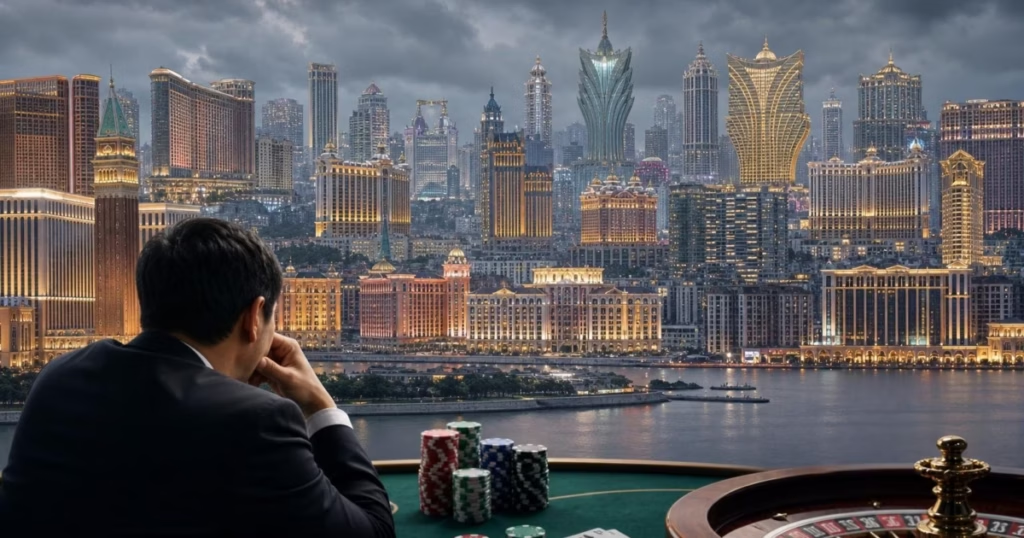
In June 2026, the landscape of Asian casinos has come under scrutiny with questions about potential oversupply in the region’s gambling sector. This discussion is significant as it affects regulatory frameworks, market dynamics, and business strategies across numerous jurisdictions. Integrated resorts across Asia, from Incheon to Australia, are experiencing financial distress. The assertion by Las Vegas Sands’ founder Sheldon Adelson in 2007 that Asia could accommodate “10 Las Vegases” is now being re-evaluated, partly due to a downturn in revenues and a more competitive market environment.
The current scenario depicts a mixed picture for the gaming industry across various Asian markets. In the Philippines, for example, gaming revenue declined by 16% in the first quarter of the year, and several properties remain unsold. Japan, despite being the third-largest economy and a growing tourist destination post-COVID-19, saw a lackluster response with only one qualified bidder for its three integrated resort licenses in 2022. In Macau, despite gross gaming revenue exceeding that of Las Vegas last year, five out of six concessionaires reported earnings below their 2019 levels. According to Paul Steelman, CEO of Steelman Partners, there is an evident excess of casinos throughout the region.
Industry analysts offer varying perspectives on the issue of potential oversaturation. John DeCree, head of institutional investor research at CBRE Capital Advisors, suggests that while “supply glut” might be an oversimplification, several markets and projects are struggling to reach anticipated performance levels. In a 2019 report, DeCree and his co-author Grant Govertsen projected an Asian gaming glut with new developments valued at over $65 billion expected by 2025. The pandemic, however, altered these dynamics by slowing the anticipated supply influx.
Since 2019, approximately $21 billion has been invested into Asian land-based gaming, yet the return on investment remains negligible, raising concerns about the sustainability of such expansions. Nicola Greenaway, managing director of Nikau Design Group, describes the current phase as a recalibration rather than expansion, with mismatches between capacity and demand becoming more apparent. The move toward digital channels and the decline of VIP gaming have left traditional land-based casinos underutilized.
Despite the challenges, some stakeholders believe the concept of a casino glut may not fully capture the complexities of the market. Vitaly Umansky, senior analyst at Seaport Research Partners, argues that some markets like Korea and the Philippines might be experiencing oversupply, while others, such as Singapore, seem undersupplied. The crux of the problem, according to many, is a mismatch between product offerings and market demands, particularly in properties designed for high-end Chinese gamblers.
Several experts emphasize the need for a strategic shift in the Asian gaming industry. Andy Choy, a veteran gaming executive, notes that the focus on luxury amenities and high-roller strategies has led to a product-market mismatch, urging a pivot towards more diversified and innovative offerings. There remains an underserved mid-market segment in Asia, suggesting potential for growth if addressed appropriately.
Specific properties such as Macau’s Sands Cotai Central, recently converted into The Londoner, and the challenges faced by integrated resorts in regions like Incheon, Vietnam, and Brisbane add layers to the existing complexity. The economic headwinds, combined with regulatory constraints and the evolution of consumer preferences, are pushing the industry to reassess its strategies.
In Macau, the restructuring of Sands Cotai Central to The Londoner and the ongoing conversion of mass-market rooms to exclusive high-roller suites are examples of “premiumisation.” However, the decline in VIP gaming, attributed to the collapse of junket operations and a sluggish Chinese economy, continues to impact Macau. Moreover, the collective non-gaming investment commitments from concessionaires further strain financial resources.
Going forward, the region’s gaming industry is expected to adapt by adopting smarter, more demand-driven approaches rather than merely scaling down. The strategic focus will likely shift towards understanding genuine demand in local contexts, as seen in distressed integrated resorts like Inspire in Incheon and Hoiana in Vietnam. These projects, which started with ambitious visions, have faced significant hurdles due to reliance on foreign tourists and shifting market dynamics.
Mohegan Gaming’s development of Inspire in South Korea, for instance, underscores the challenges of operating foreigner-only casinos without local participation. Similarly, the evolution of Queen’s Wharf Brisbane demonstrates the difficulty of attracting high-net-worth international clients amidst regulatory changes and competition from local gaming options.
The next steps for the Asian gaming industry will be crucial. As stakeholders navigate these complexities, there will be an emphasis on regulatory reviews, strategic adjustments, and market responses. Going forward, developments in regulatory frameworks, market strategies, and adaptive business models will shape the future of the gaming industry in Asia.
 4.1/5
4.1/5